Neuro Virtual Reality Autism Spectrum Disorder
Electroencephalography (EEG)
Virtual Reality
ASD
Our Objectives
The NeuroVR project aims to advance the scientific understanding of emotional processing in individuals with and without Autism Spectrum Disorder (ASD) through the integration of advanced neurotechnologies and immersive systems. Specifically, NeuroVR seeks to:
Develop an experimental framework that combines electroencephalography (EEG) and immersive Virtual Reality (VR) within a Brain–Computer Interaction (BCI) paradigm for the controlled elicitation and analysis of emotional responses.
Identify and characterize neurophysiological patterns associated with the perception and processing of basic emotions, enabling objective differentiation between ASD and neurotypical populations.
Enhance the precision and ecological validity of emotional assessment by using adaptive virtual environments capable of modulating stimuli in response to real-time neural activity.
Support the development of future diagnostic, therapeutic, and educational tools by providing robust neurophysiological evidence and transferable methodologies applicable to clinical and applied contexts.
What is NeuroVR?
NeuroVR is a research project led by the University of Valencia that aims to advance the understanding of emotional processing through the integration of immersive Virtual Reality and neurophysiological analysis. The project focuses on combining electroencephalography (EEG) and Brain–Computer Interaction (BCI) methodologies within controlled virtual environments to objectively study emotional responses in individuals with and without Autism Spectrum Disorder (ASD). By leveraging data-driven analysis of neural signals elicited during immersive experiences, NeuroVR seeks to generate high-quality scientific evidence, support the development of future diagnostic and therapeutic approaches, and contribute to innovation in neurotechnology applied to clinical, educational, and inclusive contexts.


The project promotes the development of high-value experimental frameworks for neurotechnology and affective computing, with a specific focus on emotional processing and Autism Spectrum Disorder. Through controlled use cases—such as the elicitation of basic emotions within immersive virtual environments, real-time recording of neurophysiological responses via EEG, and adaptive modulation of stimuli within a Brain–Computer Interaction paradigm—NeuroVR serves as a scientific validation platform demonstrating how immersive technologies and neural data analysis can enhance the objective assessment of emotions, improve the ecological validity of experimental protocols, and support future advances in clinical evaluation, intervention design, and evidence-based decision-making.
The initiative is coordinated by the Institute of Robotics and Information and Communication Technologies (IRTIC) at the University of Valencia, a research center specialized in the development of advanced technological solutions in areas such as immersive virtual environments, real-time interactive systems, and applied data analysis. NeuroVR builds upon the institute’s extensive experience in virtual reality, neurotechnology, and ICT applied to Autism Spectrum Disorder, integrating engineering, clinical neuroscience, and experimental research to establish a robust scientific framework for the study of emotional processing in controlled and ecologically valid conditions.

About Us
IRTIC (Institute of Robotics and Information and Communication Technologies) is a research center at the University of Valencia (UV), specialized in the development of innovative solutions in fields such as artificial intelligence, immersive environments, data interoperability, and real-time systems. Its multidisciplinary teams lead research, development, training, and technology transfer projects with applications in healthcare, transport, public administration, and digital transformation.
News

The UV Presents its Latest Technological Advances at VDS
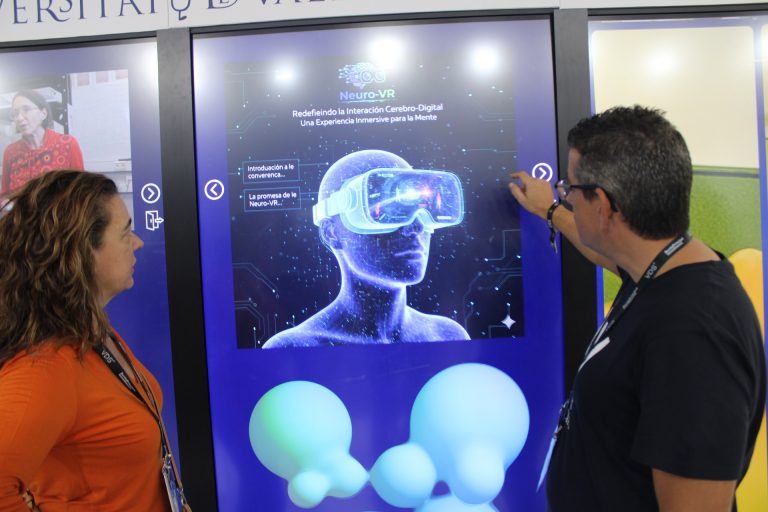
NeuroVR at Valencia Digital Summit 2025
In October 2025, the NeuroVR project was presented as part of the Valencia Digital Summit (VDS) 2025, one of the premier technology and innovation events in Spain, held at the City of Arts and Sciences in Valencia. The Summit convenes multidisciplinary research groups, startups, industry representatives and public institutions to showcase cutting-edge scientific and technological developments addressing real-world challenges.
NeuroVR’s participation underscored its research relevance within the broader ecosystem of digital innovation. Delegates and attendees were able to engage directly with the conceptual foundations and methodological advances of the project, particularly its integration of immersive Virtual Reality (VR) and neurophysiological measurement for the objective study of emotional processing. The project’s presence at the event contributed to highlighting how advanced experimental neurotechnology can be translated towards impactful applications in clinical research, inclusive health technologies, and evidence-based cognitive assessment.
By situating NeuroVR within the context of the university’s broader portfolio of scientific contributions, the Summit amplified awareness of its potential to bridge fundamental research and applied innovation. NeuroVR’s exhibition at VDS 2025 reinforced its alignment with contemporary technological trajectories and demonstrated the project’s commitment to engaging with the scientific community, industry partners, and public stakeholders.
FAQs
Got questions? We’ve got answers.
Browse our FAQs for clear and simple solutions.
What is NeuroVR?
NeuroVR is a research project focused on the study of emotional processing through the integration of immersive Virtual Reality (VR) and electroencephalography (EEG) within a Brain–Computer Interaction (BCI) framework. The project investigates neurophysiological responses to controlled emotional stimuli in individuals with and without Autism Spectrum Disorder (ASD).
What is the main scientific objective of NeuroVR?
The primary objective of NeuroVR is to identify and characterize neurophysiological patterns associated with the perception and processing of basic emotions. By combining immersive environments with real-time EEG recording, the project aims to generate objective, data-driven evidence of differences in emotional processing between ASD and neurotypical populations.
How does Virtual Reality contribute to the research?
Virtual Reality provides controlled, immersive, and reproducible environments capable of eliciting specific emotional responses with high ecological validity. In NeuroVR, VR allows precise manipulation of visual, auditory, and contextual stimuli, enabling systematic experimentation while maintaining participant engagement and experimental consistency.
What role does EEG play in the project?
EEG is used to record brain activity in real time during exposure to emotional stimuli in virtual environments. NeuroVR analyzes EEG signals using spectral, connectivity, and event-related potential (ERP) methods to extract neurophysiological markers associated with emotional processing and social cognition.
Is NeuroVR intended for clinical use?
NeuroVR is a research-oriented project and does not constitute a diagnostic or therapeutic tool. However, its results are expected to support the future development of evidence-based clinical, educational, and therapeutic applications by providing validated methodologies and objective neurophysiological insights.
Who can benefit from the results of NeuroVR?
The outcomes of NeuroVR are relevant to researchers in neuroscience and affective computing, clinicians working in neurodevelopmental disorders, educators designing inclusive learning strategies, and technologists developing neuroadaptive systems. The project also contributes to broader scientific understanding of emotion, cognition, and human–technology interaction.
Still have questions?
University Research Institute of Robotics and Information and Communication Technologies

Proyecto financiando por la Generalitat Valenciana (GVANEXT), con fondos de la Unión Europea (NextGenarationEU), mediante el PRTR